Price Action Trading Explained: Why It’s a Powerful Confirmation Tool, Not a Standalone Strategy
Understanding the Crucial Role of Price Action in Professional Forex and Algo Trading
When traders hear the term Price Action Trading, many immediately think of candlestick patterns, support and resistance levels, or trading without relying on technical indicators. While price action is popular among retail traders, beginners often mistakenly believe that mastering price action alone is enough to build a profitable trading strategy.
However, professional traders and algo developers view price action differently.
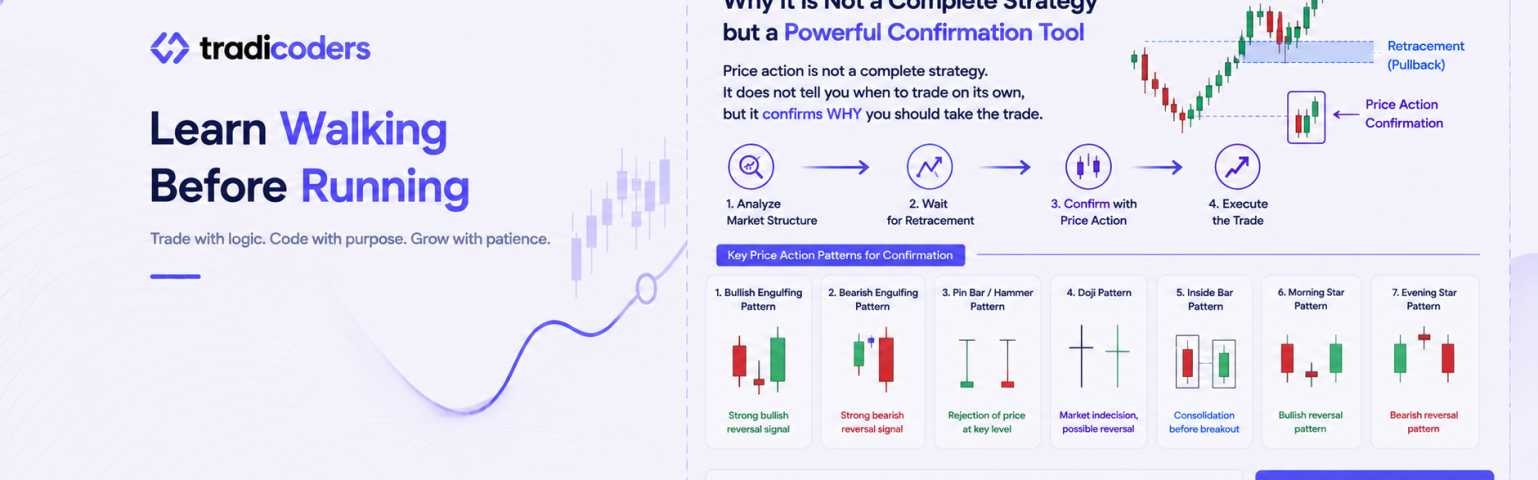
Price Action is not a complete trading strategy by itself but a powerful confirmation tool that enhances almost any trading strategy, including MT4 and MT5 Expert Advisors (EAs), by providing final entry validation.
A robust trading strategy involves multiple components: identifying market direction, key price levels, liquidity zones, and trade conditions. Once these elements align, price action serves as the final confirmation before executing a trade.
Instead of asking:
“Can this candlestick pattern alone make me profitable?”
Professional traders ask:
“Does this price action pattern confirm an already strong trading setup?”
This mindset separates random pattern trading from structured, algorithmic trading strategies.
Why Price Action Matters in Modern Forex and Algo Trading
The market is dynamic and constantly evolving. While indicators provide useful data, they are mathematical calculations based on historical prices. Price action, in contrast, reflects the real-time battle between buyers and sellers.
Each candle on a chart represents market sentiment:
- A strong bullish candle indicates aggressive buying pressure.
- A long wick signals price rejection at key levels.
- Consolidation zones reveal market indecision before potential breakouts.
Learning price action empowers traders and MQL5 developers to interpret market behavior beyond indicator signals, which is essential for scalping, swing trading, and automated trading strategies.
Price action techniques apply across various markets and trading styles:
- Forex Trading
- Gold Trading (XAUUSD)
- Cryptocurrency Trading
- Indices and Stock Trading
- Scalping and Day Trading
- Swing Trading
Using Price Action as the Final Confirmation in MT4/MT5 Trading Strategies
One common mistake is entering trades solely based on popular candlestick patterns without context.
For example, a trader might see a bullish engulfing candle and immediately buy. But where did this pattern form?
- Is it inside a significant demand zone?
- Does the market structure support a bullish trend?
- Was there a recent liquidity sweep?
- Is the overall trend aligned with the trade direction?
Without this context, even strong price action patterns can fail.
The best approach is to use price action as the final step in a comprehensive trading process.
Step 1: Identify Market Direction
Analyze the overall market structure to determine trend direction.
- Higher highs and higher lows indicate an uptrend.
- Lower highs and lower lows indicate a downtrend.
A Market Structure Breakout (MSB) may signal a trend reversal or continuation.
Step 2: Wait for a Retracement
After a breakout, wait for price to retrace to a key level such as:
- Previous resistance turned support
- Supply and demand zones
- Order blocks
- Fibonacci retracement levels
- Liquidity zones
This retracement offers a better risk-to-reward entry opportunity.
Step 3: Use Price Action as Confirmation
Once price reaches the expected area, wait for a confirming price action pattern.
Example sequence:
- Market structure is bullish
- Price retraces into a demand zone
- A bullish engulfing candle forms
Market Structure → Retracement → Price Action Confirmation → Entry
Here, the engulfing pattern confirms buyer strength and validates the trade setup.
Popular Price Action Patterns Every Forex and Algo Trader Should Know
Recognizing common price action patterns helps traders and MQL5 developers improve trade timing and market psychology understanding.
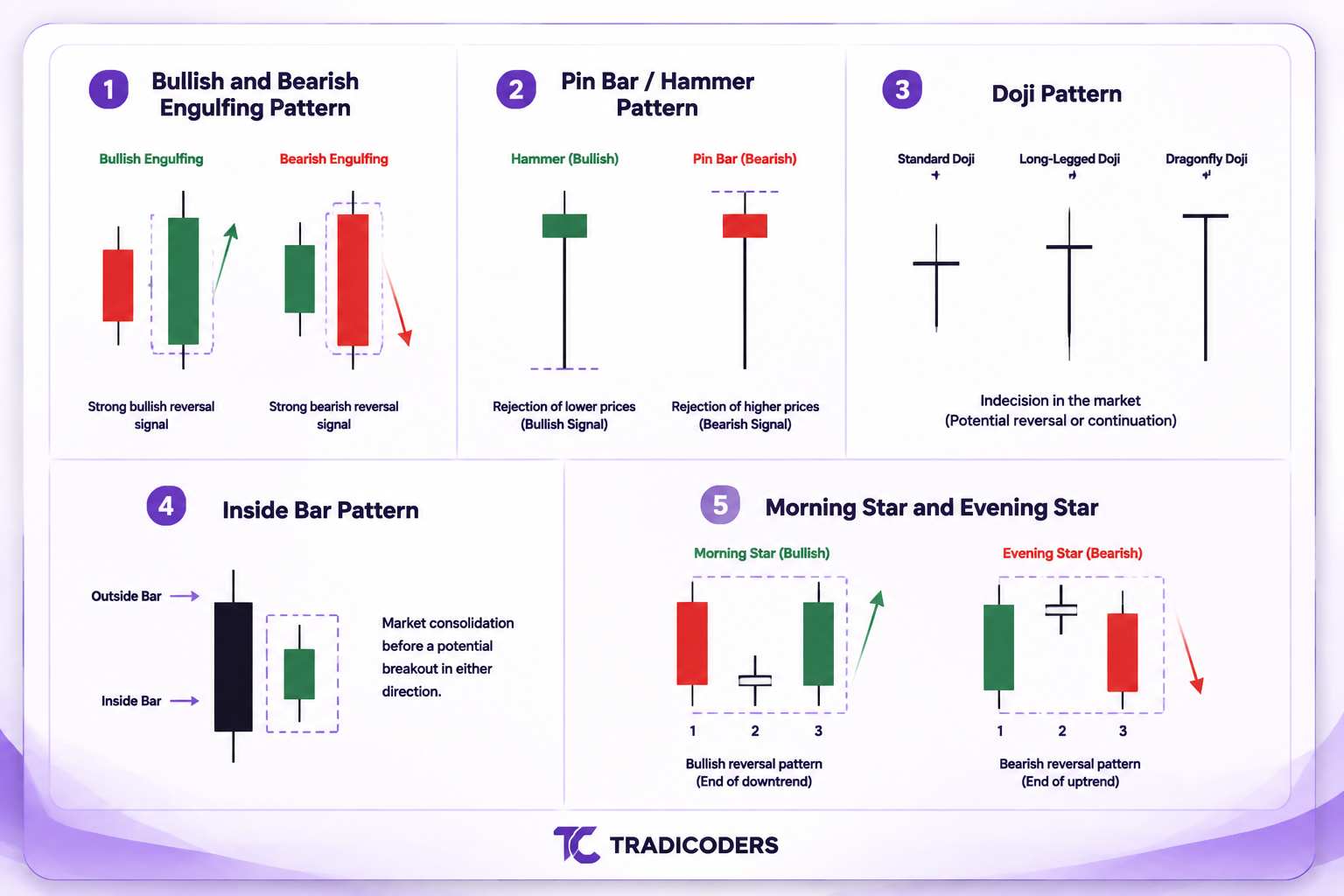
1. Bullish and Bearish Engulfing Patterns
Bullish Engulfing
A bullish engulfing pattern occurs when a strong bullish candle fully covers the previous bearish candle, indicating buyer dominance.
Commonly used at demand zones, after bearish retracements, or during uptrend continuations.
Bearish Engulfing
A bearish engulfing pattern forms when sellers create a strong bearish candle that engulfs the previous bullish candle, signaling potential reversals or downtrend continuation.
2. Pin Bar / Hammer Pattern
Pin Bars have long wicks showing rejection from key price levels.
- Bullish pin bar: Sellers push price lower, but buyers reject those lows.
- Bearish pin bar: Buyers push price higher, but sellers regain control.
Pin bars are more significant near support/resistance, supply/demand zones, or market structure levels.
3. Doji Pattern
Doji candles indicate market indecision with balanced buying and selling pressure.
While not a standalone signal, Dojis gain value when combined with strong support/resistance, trend exhaustion, or structural changes.
4. Inside Bar Pattern
An Inside Bar forms when a smaller candle is completely within the range of the previous candle, often signaling consolidation before a breakout.
Used to identify continuation setups after strong moves.
5. Morning Star and Evening Star Patterns
These three-candle reversal patterns indicate potential trend reversals.
Morning Star
Appears after a decline, signaling a bullish reversal.
Evening Star
Appears after an uptrend, signaling a bearish reversal.
Stronger when appearing at key market levels.
Integrating Price Action with Other Trading Concepts for MT5 EA Development
Top traders and MQL5 developers rarely rely solely on price action. They combine it with:
- Market Structure Analysis
- Supply and Demand Zones
- Support and Resistance Levels
- Liquidity Analysis
- Trend Analysis
- Volume Analysis
- Technical Indicators
Example setups include:
- Market Structure Breakout + Supply Zone + Bearish Engulfing Pattern
- Demand Zone + Liquidity Sweep + Bullish Pin Bar
This layered approach creates logical, high-probability trade sequences, ideal for both manual and automated MT5 Expert Advisors.
Why Every Trader and Algo Developer Should Master Price Action
Even when using indicators, Expert Advisors, or automated trading systems, understanding price action deepens market insight.
Price action helps traders and developers:
- Interpret buyer and seller behavior
- Improve trade entry timing
- Filter out low-quality signals
- Confirm trading setups effectively
- Identify stronger support and resistance zones
- Enhance risk management strategies
Price action does not replace a trading strategy—it enhances it.
Final Thoughts
Price Action Trading is a vital skill for traders and MQL5 developers, but it must be applied correctly.
It is not a standalone strategy that guarantees profits by spotting candlestick patterns alone. Instead, it serves as a powerful confirmation tool that improves decision-making after thorough market analysis.
The most effective trading approaches follow a sequence:
Market Analysis → Strategy Setup → Key Price Level Identification → Price Action Confirmation → Trade Execution
By mastering price action patterns and understanding their context, traders and algo developers can add a crucial final layer of confirmation to almost any trading strategy, including custom MT4/MT5 Expert Advisors.