
Price Action Trading: Why It Is Not a Complete Strategy but a Powerful Confirmation Tool
Understanding the Real Role of Price Action in Professional Trading
When traders hear the term Price Action Trading, many immediately think about candlestick patterns, support and resistance, or trading without indicators. Because of its popularity, many beginners believe that learning price action alone is enough to become a successful trader.
However, professional traders often look at price action from a different perspective.
Price Action is not necessarily a complete trading strategy by itself. It is a powerful component that can improve almost any trading strategy by providing the final confirmation before entering a trade.
A strong trading strategy is usually built from multiple steps. Market direction, important price levels, liquidity areas, and trade conditions should be identified first. After these elements are aligned, price action can become the final puzzle piece that helps traders decide whether a trade has enough confirmation.
Instead of asking:
"Can this candlestick pattern make me profitable?"
Professional traders ask:
"Does this price action pattern confirm an already strong trading setup?"
This difference in mindset separates random pattern trading from structured trading.
Why Price Action Is Important in Modern Trading
The market is constantly changing. Indicators can provide useful information, but they are mathematical calculations based on previous price movements. Price action, on the other hand, focuses directly on what buyers and sellers are doing at the current moment.
Every candle represents a battle between buyers and sellers.
A strong bullish candle can show aggressive buying pressure.
A long wick can show rejection from a certain price level.
A consolidation area can show uncertainty before a potential breakout.
By learning price action, traders develop the ability to understand market behavior instead of only following signals.
This skill is useful because price action can be applied to almost every trading style:
-
Forex Trading
-
Gold Trading (XAUUSD)
-
Cryptocurrency Trading
-
Index Trading
-
Stock Trading
-
Scalping
-
Day Trading
-
Swing Trading
Price Action Works Best as the Final Confirmation
One of the biggest mistakes traders make is entering a trade only because they see a popular candle pattern.
For example:
A trader sees a bullish engulfing candle and immediately buys.
But where did this pattern appear?
-
Was it inside an important demand zone?
-
Was the market structure bullish?
-
Was there a previous liquidity sweep?
-
Was the overall trend supporting the direction?
Without context, even a strong candlestick pattern can fail.
A better approach is to use price action as the final step of a complete trading process.
A professional sequential strategy may look like this:
Step 1: Identify Market Direction
First, traders analyze the overall market structure.
For example:
-
Higher highs and higher lows indicate an uptrend.
-
Lower highs and lower lows indicate a downtrend.
A Market Structure Breakout (MSB) can indicate that market direction may be changing.
Step 2: Wait for a Retracement
After a breakout, experienced traders usually avoid entering immediately.
Instead, they wait for price to return to an important area.
This area could be:
-
Previous resistance becoming support.
-
Supply and demand zone.
-
Order block.
-
Fibonacci retracement area.
-
Liquidity zone.
The retracement provides a better risk-to-reward opportunity.
Step 3: Use Price Action as Confirmation
After price reaches the expected area, traders wait for confirmation.
For example:
The market structure becomes bullish.
Price retraces into a demand zone.
A bullish engulfing pattern appears.
Now the trader has a complete sequence:
Market Structure → Retracement → Price Action Confirmation → Entry
In this situation, the engulfing pattern is not the strategy itself. It is the final confirmation that buyers are showing strength.
Popular Price Action Patterns Every Trader Should Learn
Now let's look at the most popular price action patterns that traders use for confirmation:
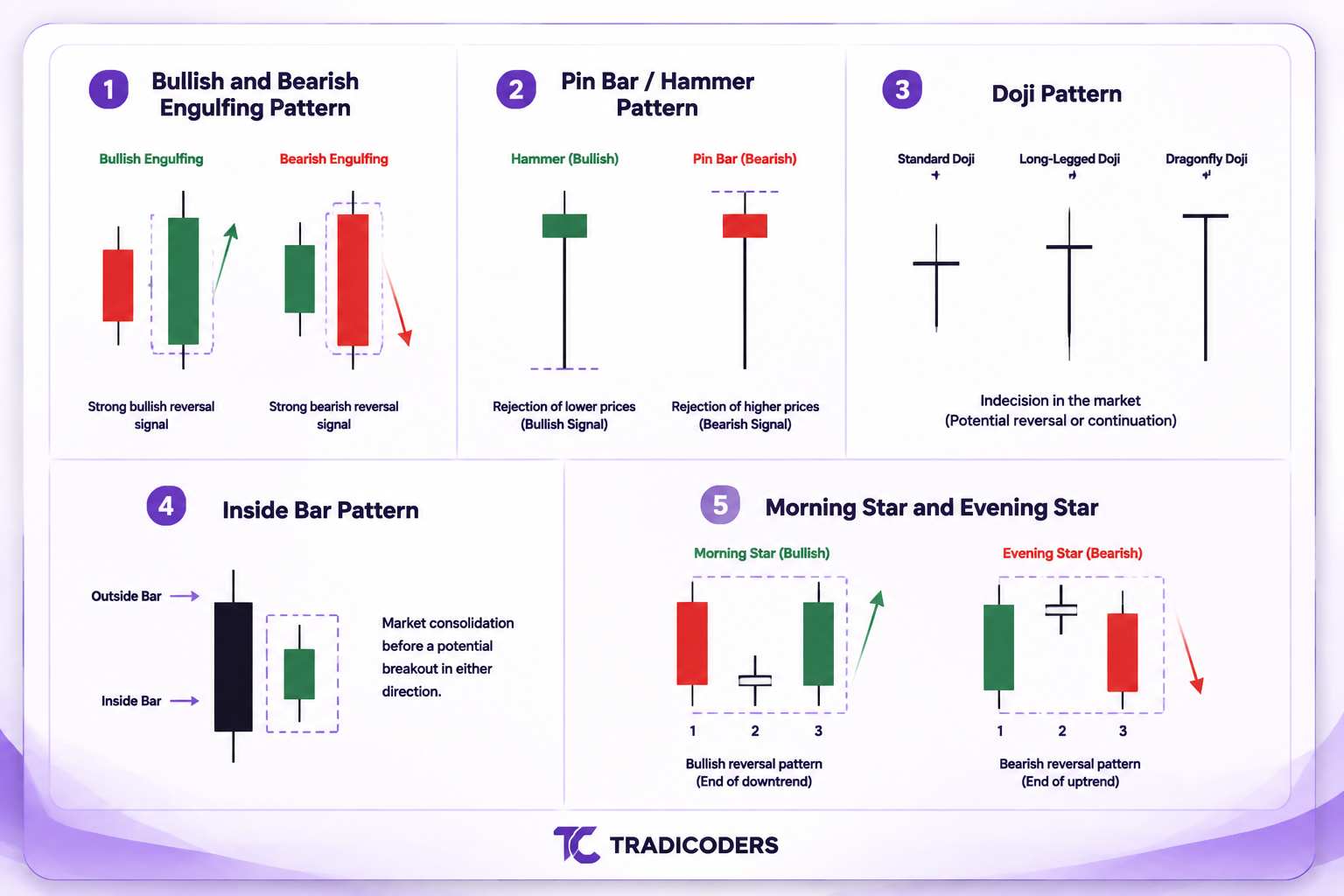
Learning common price action patterns can help traders recognize market psychology and improve trade timing.
1. Bullish and Bearish Engulfing Pattern
The Engulfing pattern is one of the most popular price action formations.
Bullish Engulfing
A bullish engulfing pattern appears when a strong bullish candle completely covers the previous bearish candle.
It can indicate that buyers have taken control.
Traders often look for bullish engulfing patterns:
-
At demand zones.
-
After a bearish retracement.
-
During an uptrend continuation.
Bearish Engulfing
A bearish engulfing pattern occurs when sellers overwhelm buyers and create a strong bearish candle covering the previous bullish candle.
It is commonly used for:
-
Reversal confirmation.
-
Resistance area entries.
-
Downtrend continuation.
2. Pin Bar / Hammer Pattern
The Pin Bar is a candle with a long wick showing rejection from a specific price area.
A bullish pin bar suggests that sellers pushed the price lower, but buyers rejected those lower prices.
A bearish pin bar suggests that buyers attempted to push higher, but sellers regained control.
Pin bars become more meaningful when they appear near:
-
Support and resistance.
-
Supply and demand zones.
-
Key market structure levels.
3. Doji Pattern
A Doji candle forms when buyers and sellers are temporarily balanced.
It shows market uncertainty.
A Doji alone is not a trading signal, but it can become valuable when combined with:
-
Strong support or resistance.
-
Trend exhaustion.
-
Market structure changes.
4. Inside Bar Pattern
An Inside Bar forms when a smaller candle develops completely inside the range of the previous candle.
It often represents market consolidation before a potential breakout.
Many traders use Inside Bars after strong movements because they can indicate a continuation setup.
5. Morning Star and Evening Star
These are three-candle reversal patterns.
Morning Star
Usually appears after a decline and can indicate potential bullish reversal.
Evening Star
Usually appears after an increase and can indicate potential bearish reversal.
Like all price action patterns, they become stronger when they appear at important market locations.
Combining Price Action With Other Trading Concepts
The strongest traders rarely use price action alone.
They combine it with other forms of analysis:
-
Market Structure
-
Supply and Demand
-
Support and Resistance
-
Liquidity Analysis
-
Trend Analysis
-
Volume Analysis
-
Technical Indicators
For example:
A trader may combine:
Market Structure Breakout + Supply Zone + Bearish Engulfing Pattern
or:
Demand Zone + Liquidity Sweep + Bullish Pin Bar
This creates a logical trading sequence instead of relying on a single signal.
Why Every Trader Should Learn Price Action
Even if you use indicators, Expert Advisors, or automated systems, understanding price action provides a deeper understanding of the market.
Price action helps traders:
-
Understand buyer and seller behavior.
-
Improve entry timing.
-
Avoid low-quality signals.
-
Confirm trading setups.
-
Identify stronger support and resistance areas.
-
Improve risk management.
It does not replace a trading strategy—it improves the strategy.
Final Thoughts
Price Action is one of the most valuable skills a trader can develop, but it should be understood correctly.
It is not a magical strategy that creates profitable trades by simply finding candlestick patterns. Instead, it is a powerful confirmation tool that helps traders make better decisions after completing their market analysis.
The best trading approaches are usually sequential:
Market Analysis → Strategy Setup → Important Level → Price Action Confirmation → Trade Execution
By learning price action patterns and understanding where they appear, traders can add an important final layer of confirmation to almost any trading strategy.


