
Learn Price Action as the Final Confirmation of Any Trading Strategy
Introduction: Price Action Is Not a Complete Strategy
Many traders learn Price Action as if it were a complete trading strategy. They memorize candlestick patterns, search for engulfing candles, pin bars, dojis, and other formations, and then try to trade every pattern they find.
But this approach can create a major problem.
Price Action is not necessarily a complete trading strategy. It can be one of the most important final components of a complete strategy.
The strongest trading systems are often sequential strategies. Instead of making a trading decision from one signal, they require several conditions to be confirmed one after another.
For example:
Market Direction → Key Level → Retracement → Setup → Price Action Confirmation → Entry
Each step answers a different question. The final Price Action confirmation can answer one of the most important questions:
Why Advanced Trading Strategies Are Sequential
A professional trading strategy rarely depends on only one condition.
Consider a trader who wants to buy a market. They may first need to establish that the market is bullish. Then they may wait for price to retrace toward an important level. After reaching that level, they still do not immediately enter.
Why?
Because reaching a level does not mean that the market has already started moving in the expected direction.
The trader needs evidence.
This creates a sequential process:
-
Identify the market direction.
-
Wait for price to reach a specific area.
-
Wait for the expected retracement.
-
Look for confirmation.
-
Enter when the movement begins.
This is where Price Action becomes extremely valuable.
Price Action Can Show the Start of the Expected Movement
Price Action is essentially the study of how price behaves.
Markets continuously create candles and structures because buyers and sellers are interacting with each other.
When buying or selling pressure changes significantly, that change can appear on the chart as a recognizable pattern.
For example:
-
Engulfing Pattern
-
Pin Bar
-
Hammer
-
Shooting Star
-
Inside Bar
-
Morning Star
-
Evening Star
These patterns can provide evidence that market pressure is changing.
However, the pattern itself is not necessarily the reason to enter.
Its importance comes from where and when it happens.
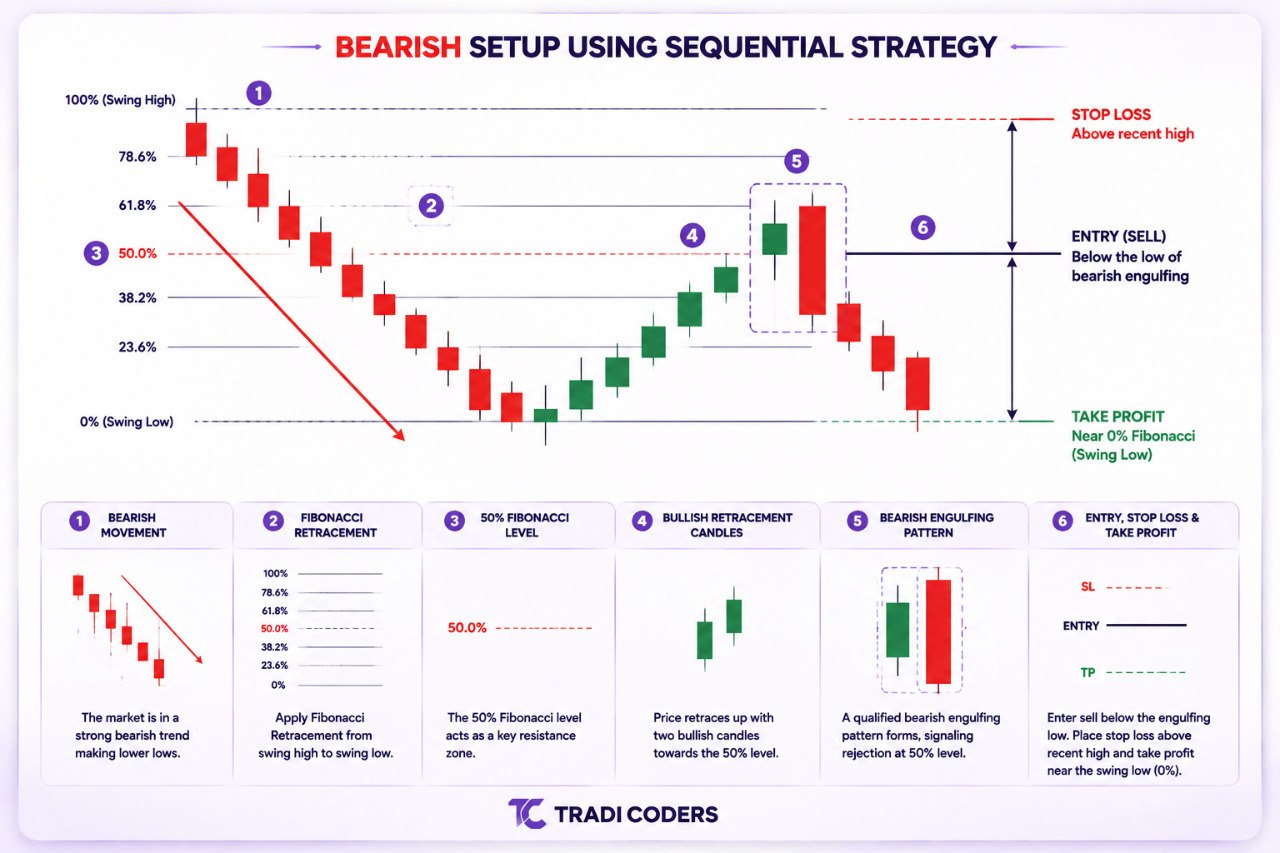
Example 1: Fibonacci Retracement + Price Action Confirmation
Let's consider a simple example using a Fibonacci Retracement strategy.
Suppose our strategy is looking for a bearish continuation.
The strategy can have three major steps.
Step 1: Identify the Initial Movement
First, the market must create a meaningful bearish movement.
For example:
Strong bearish movement → New low
We now know that sellers have demonstrated significant strength.
But we do not want to sell immediately.
Step 2: Wait for the Retracement
After the bearish movement, price begins moving upward.
This is the retracement.
We apply Fibonacci Retracement and identify the 50% Fibonacci level as an important area.
Now we wait.
Price reaches the 50% level.
But we still do not automatically sell.
Why?
Because price reaching 50% does not prove that the bearish movement has resumed.
Step 3: Wait for Price Action Confirmation
Suppose price reaches the 50% Fibonacci level and creates two consecutive bullish candles.
At this point, some traders may think:
"Price is going up, so the bearish idea was wrong."
But our strategy is waiting for something more specific.
Then a strong Bearish Engulfing Pattern appears.
Now the sequence becomes:
Bearish Movement → Fibonacci Retracement → 50% Level → Bullish Retracement → Bearish Engulfing → Entry
This is a completely different approach from simply trading every Bearish Engulfing Pattern.
The engulfing pattern is the final confirmation that sellers may be returning.
Fibonacci + Bearish Engulfing Strategy Example
Why the Engulfing Pattern Is Important in This Example
Imagine that price touches the 50% Fibonacci level and continues producing bullish candles.
The Fibonacci level alone has not provided confirmation.
But when a strong bearish candle completely overtakes the previous bullish candle, something has changed.
The market has shown that sellers are willing to enter with enough strength to overcome the recent buying pressure.
The pattern therefore becomes useful as evidence that the retracement may be ending.
This is the real value of Price Action.
It can help answer:
Example 2: Market Structure Breakout + Retracement + Price Action
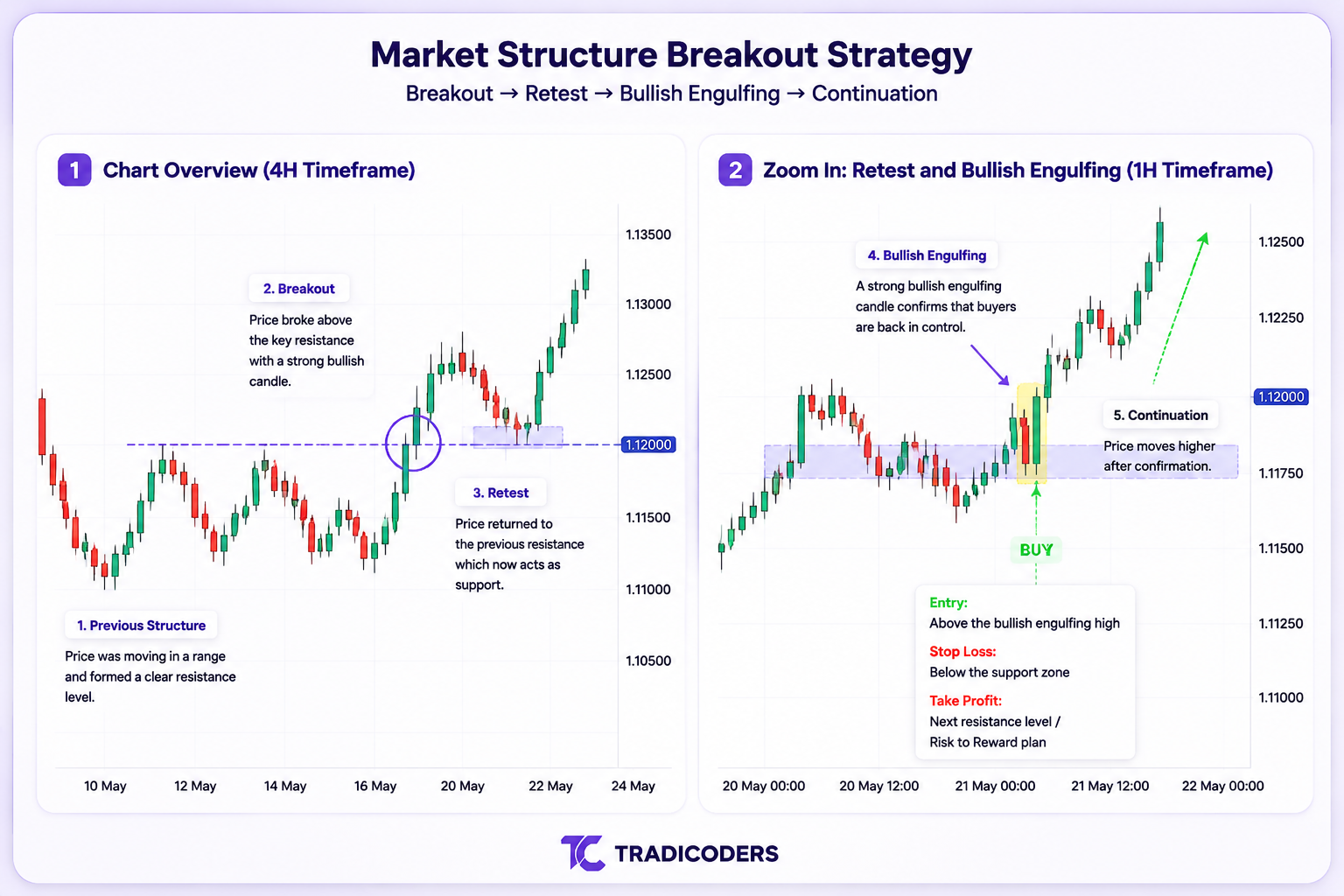
Another sequential strategy can be based on Market Structure Breakout (MSB).
Imagine the market breaks above a previous resistance.
The first step is:
Market Structure Breakout
Instead of entering immediately, the trader waits for a retracement.
Price returns toward the broken resistance.
Now the old resistance may act as support.
The trader waits for Price Action confirmation.
A possible sequence is:
Bullish Breakout → Retracement → Previous Resistance/Support → Bullish Engulfing → Buy
Here, the Bullish Engulfing Pattern is not the complete strategy.
It is the final piece that confirms that buyers may be returning after the retracement.
Market Structure Breakout Strategy
Example 3: Support and Resistance + Price Action
Price Action can also be used with traditional support and resistance.
Imagine EUR/USD reaches a major support zone.
The strategy does not simply say:
"Price reached support, therefore buy."
Instead:
Step 1
Identify strong support.
Step 2
Wait for price to reach the zone.
Step 3
Observe how price behaves around the zone.
Step 4
Wait for a bullish Price Action pattern.
For example:
Support → Rejection → Bullish Pin Bar → Bullish Engulfing → Entry
Now the trader has more information than simply knowing that price reached support.
Example 4: Trend Following + Price Action
Price Action can also be the final confirmation in a trend-following strategy.
Imagine the market is clearly bullish.
The trader waits for a bearish retracement.
Price reaches an important moving average or previous support.
Instead of buying immediately, the trader waits for a bullish pattern.
For example:
Bullish Trend → Bearish Retracement → Support → Bullish Engulfing → Continuation
Again, the engulfing pattern is not the entire strategy.
It is the final confirmation inside a larger process.
Price Action Patterns Represent Changes in Volatility
There is another important way to understand Price Action.
Market movement and volatility often paint themselves as patterns on the chart.
When volatility increases, candles can become larger and directional movement can become more obvious.
For example, a market may spend several candles moving slowly during a retracement. Suddenly, a large bullish or bearish candle appears.
That change in candle behavior can tell us that market participation has changed.
This is why traders should not only memorize the name of a pattern.
They should learn to understand:
-
Candle body size.
-
Shadow size.
-
Direction.
-
Previous candles.
-
Volatility.
-
Market structure.
-
Location.
A Bearish Engulfing Pattern at major resistance after a long bullish retracement is much more interesting than an identical pattern appearing randomly in the middle of a sideways market.
The Same Pattern Can Have Completely Different Meanings
This is one of the most important lessons for beginners.
Imagine you see a Bullish Engulfing Pattern.
Scenario A:
Bullish Engulfing in the middle of a sideways range
There may be little reason to trade it.
Scenario B:
Bullish Engulfing at major support after a bearish retracement inside a larger bullish trend
Now the pattern has much more context.
The candle formation is similar.
The market story is different.
This is why professional Price Action analysis focuses on context rather than simply recognizing patterns.
Higher Timeframes Can Improve Price Action Analysis
Another useful approach is starting with a higher timeframe.
Instead of immediately searching for patterns on a 1-minute or 5-minute chart, traders can first analyze:
-
Daily
-
4-Hour
-
1-Hour
Then they can move to a lower timeframe for their actual entry strategy.
For example:
H4 → Market Direction
H1 → Important Level
M15 → Retracement
M5 → Price Action Confirmation
The exact timeframes depend on the trader's strategy and trading style.
The important principle is:
Price Action Should Be the Last Puzzle Piece
A useful way to visualize a sequential trading strategy is as a puzzle.
Each part provides different information.
Fundamental Analysis
→ Why might the market move?
Market Structure
→ What is the market currently doing?
Support / Resistance / Fibonacci / Supply & Demand
→ Where might the movement react?
Retracement
→ Has price returned to an interesting area?
Price Action
→ Is the expected movement beginning?
When these elements align, the trader has a much more structured decision-making process.
Price Action becomes the last puzzle piece, rather than the entire puzzle.
How to Build Your Own Sequential Strategy
When designing a strategy, try asking questions in order.
Question 1: What is the market direction?
Bullish, bearish, or ranging?
Question 2: Where do I want price to reach?
Support, resistance, Fibonacci level, supply/demand zone, or another technical area?
Question 3: What movement am I waiting for?
Breakout, retracement, liquidity sweep, or another setup?
Question 4: What must happen before I enter?
This is where Price Action can become your final confirmation.
Question 5: Which pattern qualifies?
For example:
-
Bullish Engulfing
-
Bearish Engulfing
-
Pin Bar
-
Hammer
-
Shooting Star
-
Inside Bar
Question 6: Where is the invalidation point?
Finally, define Stop Loss and risk before entering.
This creates a strategy based on conditions, rather than emotions.
Don't Trade Price Action in Isolation
The biggest mistake is turning Price Action into another collection of "buy and sell signals."
For example:
"Every Bullish Engulfing = Buy."
This is not a professional trading system.
Instead:
"When my higher-timeframe trend is bullish, price retraces to my predefined area, and a qualified Bullish Engulfing Pattern confirms that buyers are returning, I consider an entry according to my risk-management rules."
The second approach is far more structured.
Final Thoughts
Learning Price Action is extremely valuable, but traders should understand what role it plays.
Price Action does not have to be your complete strategy. It can be the final confirmation that completes your strategy.
The most advanced trading systems often work sequentially:
Step 1 → Step 2 → Step 3 → Final Confirmation → Entry
Our Fibonacci example demonstrates this clearly:
Bearish Movement → 50% Fibonacci Retracement → Retracement Reaches Level → Bullish Pullback → Bearish Engulfing → Entry
The Fibonacci level identifies where we are interested.
The initial movement tells us what direction we are considering.
The retracement tells us when price has returned to the area.
And Price Action tells us whether the expected movement may be starting.
That is why learning Price Action is so important.
Don't simply learn how to recognize candles.
Learn what the candles are telling you about market behavior.
The goal is not to find more patterns.
The goal is to understand when a pattern matters.


